
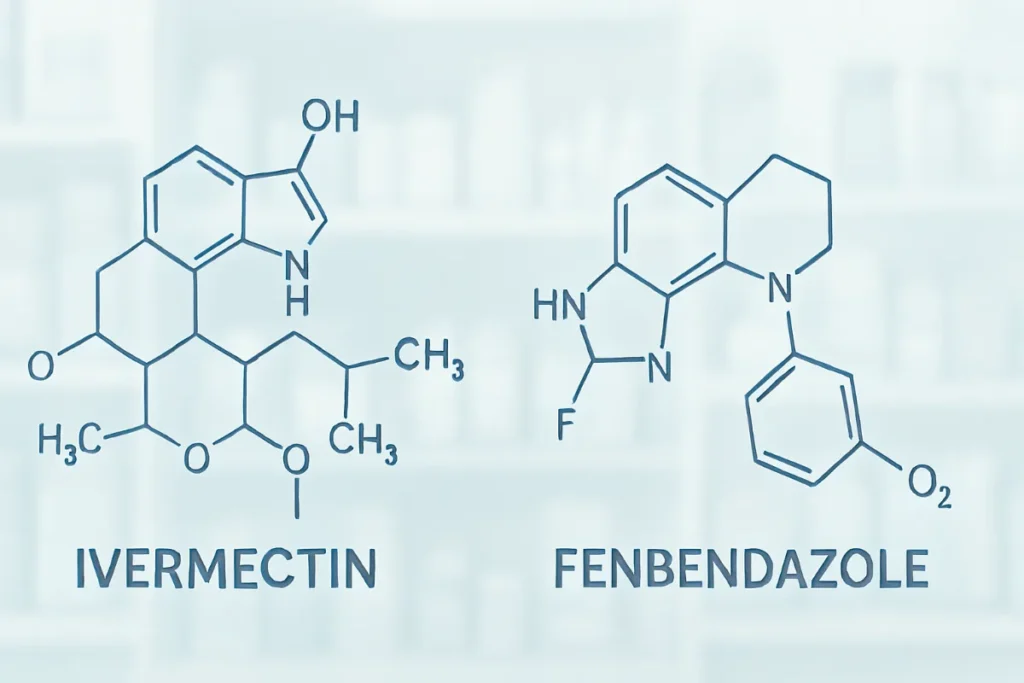
In recent years, ivermectin and fenbendazole have attracted growing attention across the UK, USA, and many other countries. Although both compounds have existed for decades, public curiosity has increased due to online discussions, research headlines, and rising interest in antiparasitic medicines. As a result, many people now search for reliable and easy-to-understand information.
Table of Contents
ToggleWhat Is Ivermectin?
Ivermectin is a well-known antiparasitic medicine developed in the 1970s. Since then, doctors and veterinarians have widely used it to treat specific parasitic infections. Moreover, global health organizations recognize ivermectin as an important medicine for controlling certain diseases.
Approved Uses of Ivermectin
In human healthcare, ivermectin is approved for:
- Treating strongyloidiasis
- Managing onchocerciasis (river blindness)
- Treating scabies and head lice in approved formulations
Additionally, veterinarians use ivermectin to control parasites in livestock and pets. Because of its effectiveness, it has played a major role in improving public health in several regions.
How Ivermectin Works
Ivermectin targets the nervous system of parasites. Specifically, it binds to channels in parasite nerve cells, which causes paralysis. As a result, the parasites can no longer survive or reproduce. Importantly, when used as approved, ivermectin does not affect human nerve cells in the same way.
What Is Fenbendazole?
Fenbendazole belongs to the benzimidazole group of antiparasitic drugs. Unlike ivermectin, fenbendazole is approved only for human & veterinary only. Veterinarians commonly prescribe it for parasite control in animals.
Common Veterinary Uses
Fenbendazole is widely used to treat:
- Roundworms
- Hookworms
- Whipworms
- Certain tapeworm infections
Furthermore, farmers and animal owners rely on fenbendazole for routine parasite management in livestock and companion animals.
How Fenbendazole Works
Fenbendazole works by blocking the parasite’s ability to absorb glucose. Consequently, the parasite loses its energy source and eventually dies. This mechanism makes fenbendazole effective against intestinal parasites in animals.
Key Differences Between Ivermectin and Fenbendazole
Although both are antiparasitic agents, ivermectin and fenbendazole differ in several important ways. Therefore, understanding these differences helps prevent confusion.
| Aspect | Ivermectin | Fenbendazole |
|---|---|---|
| Human approval | Yes (limited uses) | Yes (limited uses) |
| Main use | Human & veterinary | Human & Veterinary only |
| Drug class | Avermectin | Benzimidazole |
| Action | Affects nerve signals | Blocks glucose absorption |
In contrast to ivermectin, fenbendazole does not have approval for human treatment. Thus, regulatory status clearly separates their uses.
Why Are Ivermectin and Fenbendazole Often Discussed Together?
Many people search for ivermectin and fenbendazole together. Several factors explain this trend. First, both drugs treat parasites. Second, online discussions often group antiparasitic medicines together. Finally, increased interest in scientific research has fueled curiosity.
However, online popularity does not equal medical approval. Therefore, readers should always verify information using reliable sources.
Scientific Research and Public Interest
Researchers often study existing medicines to understand their biological properties better. Consequently, ivermectin and fenbendazole appear in laboratory and preclinical studies from time to time.
Important Points About Research
- Most studies occur in labs or animal models
- Research findings do not guarantee human use
- Regulatory approval requires long clinical trials
As a result, scientific interest should not be confused with medical recommendations.
Safety and Regulatory Considerations
Safety remains a critical topic when discussing ivermectin and fenbendazole.
Regulatory Status
- Ivermectin has approved human and veterinary uses
- Fenbendazole is approved only human & veterinary only
- Authorities strictly regulate dosage and formulation
Moreover, health agencies in the UK and USA warn against using medicines outside their approved purpose. Therefore, professional guidance remains essential.
Why Has Global Interest Increased?
Several reasons explain the rising global interest:
- People search online for health education
- Media coverage raises awareness
- Veterinary medicine remains widely used
- Scientific discussions reach the public faster
As a result, demand for accurate and neutral information has increased significantly.
How to Identify Reliable Information Online
To avoid misinformation, readers should:
- Trust official medical and scientific sources
- Avoid exaggerated or emotional claims
- Check approval status carefully
- Understand the difference between research and treatment
In this way, readers can make informed decisions.
Conclusion
Ivermectin and fenbendazole are established antiparasitic medicines with clearly defined roles. Ivermectin has approved human applications, whereas fenbendazole remains a veterinary-only drug. Although online interest continues to grow, medical approval has not changed.
Therefore, understanding their uses, differences, and limitations helps readers navigate online information responsibly and safely.